

Most brands entering Roblox face the same dilemma: where to start on Roblox?
Between 2022 and 2026, McDonald's tested nearly every Roblox marketing strategy available. The journey from their first Roblox game to their current phygital dominance reveals exactly what works for brands trying to reach the Roblox audience.
Here's the complete breakdown of McDonald's Roblox evolution, the dreakdown behind each strategy, and the lessons we can learn from their multi-million dollar Roblox Marketing strategy.
The Evolution🔎 From Standalone Games to Phygital Dominance
McDonald's Roblox strategy started the way most brands approach the platform: by building their own branded experience.
The Timeline: McDonald's Roblox Journey (2022-2026)
- 2022: Launched McDonald's Land in Latin America—a multi-island branded experience.
- 2023: Built Crispy Tattoo Island in Italy for their Crispy McBacon campaign.
- 2024: Launched McDonald's Land Tycoon—a restaurant management game with bidirectional phygital integration.
- 2024: Started game activation with Adopt Me! for Happy Meals in Europe (6 collectible toys).
- 2025: Scaled game activation with Pet Simulator(18 toys).
- 2025: Expanded Adopt Me! Campaign to Europe, Middle East, and Korea (10 toys).
Strategy #1: Owned Branded Experiences
McDonald's first approach was what most brands do: build their own Roblox game. They tested this strategy three times, learning something different from each iteration.
🟪McDonald's Land
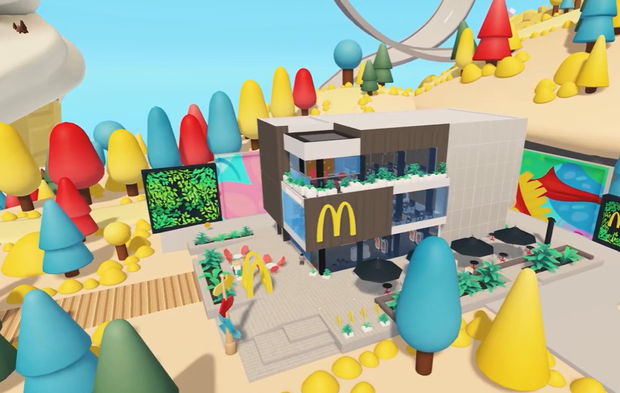
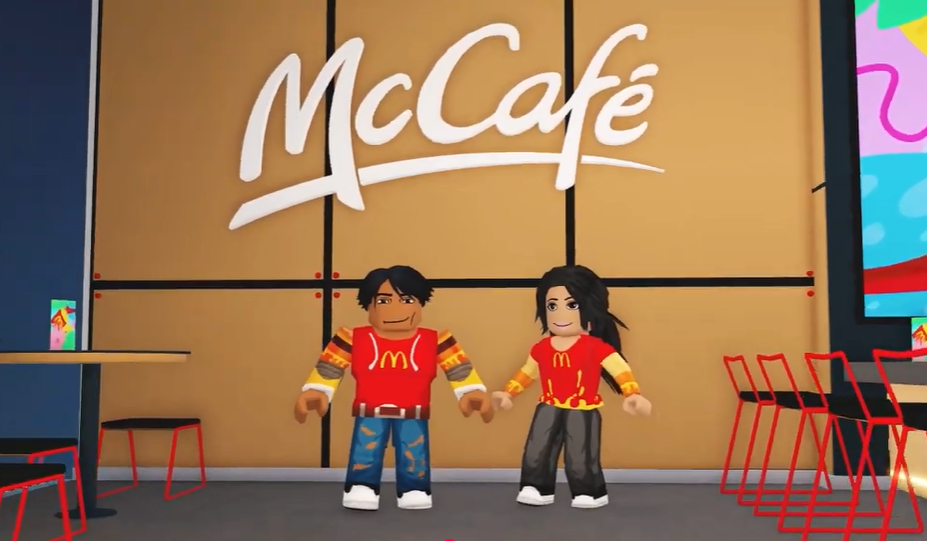
McDonald's Land was their first major Marketing investment in Roblox—a multi-island branded experience with parkour, mini-games, and virtual McDonald's restaurants.
*Note: Mcdonald's first experience on Roblox was Ronald Mcdonald House.
In McDonald's Land, players could explore themed zones based on McDonald's products—burgers, fries, ice cream, soda—run through parkour courses, complete timed tasks, earn virtual currency, and unlock McDonald's-branded avatar items.
Developed by agencies DeuSens and Playoffnations in partnership with Publicis, the Latin America campaign utilized gaming influencers to amplify reach.
📊The results: 430K visits across 10+ countries and 37,000+ orders through phygital integration across Argentina, Colombia, Mexico, and other Latin American countries. The campaign even won 2 Bronze awards at the Golden Festival for Entertainment, Gaming and Metaverse categories.
🟪Crispy Tattoo Island
McDonald's took a more focused approach with Crispy Tattoo Island, building a campaign-specific experience for the Italian market.
Developed by agency Magnet, players earned "burgers" (in-game currency) through a click-based progression system. They spawned in a fully-branded tattoo shop where they could unlock exclusive McDonald's-themed tattoos for their Roblox avatars. Rare tattoos required more gameplay to unlock.
To amplify reach, McDonald's executed a coordinated influencer campaign with Italian content creators (Fedez, Surry, Stepny, Roby, Jenny). Strong influencer integration drove initial traffic. Digital meet & greets created FOMO and social proof.
Collectible tattoos gave players a reason to return. The good rating showed players who came actually enjoyed the experience. McDonald's even updated the island for their "Summerdays" campaign later in 2023.
📊 The results: 143,000+ total map visits, 94% player satisfaction rating, and 3M+ aggregated reach across YouTube and Instagram.
🟪McDonald's Land Tycoon
McDonald's launched McDonald's Land Tycoon with Playoffnations and Publicis Play—an evolution of their original McDonald's Land concept. This was a tycoon-style experience where players could run their own virtual McDonald's restaurant.
Players take on the role of restaurant manager, preparing orders and serving customers, upgrading and customizing their locations, and unlocking exclusive content and badges as they progress.
This is where McDonald's started getting smarter => two-way phygital integration.
McDonald's Land Tycoon featured a bidirectional phygital strategy:
Game → Restaurant: players completed challenges → unlocked exclusive discount codes to be redeemed at McDonald's.
Restaurant → Game: customers purchased at physical McDonald's → unlocked decorative items for virtual restaurants.
📊 The results: while we don't have specific data, this campaign created a continuous loop connecting digital gameplay with physical restaurant visits—players had reasons to visit both the game and real McDonald's repeatedly.
Strategy #2: Phygital Breakthrough
This is where McDonald's strategy gets brilliant—partnering with winning games and create phygital loop through Happy Meals.
🟦Adopt Me! & Pet Simulator
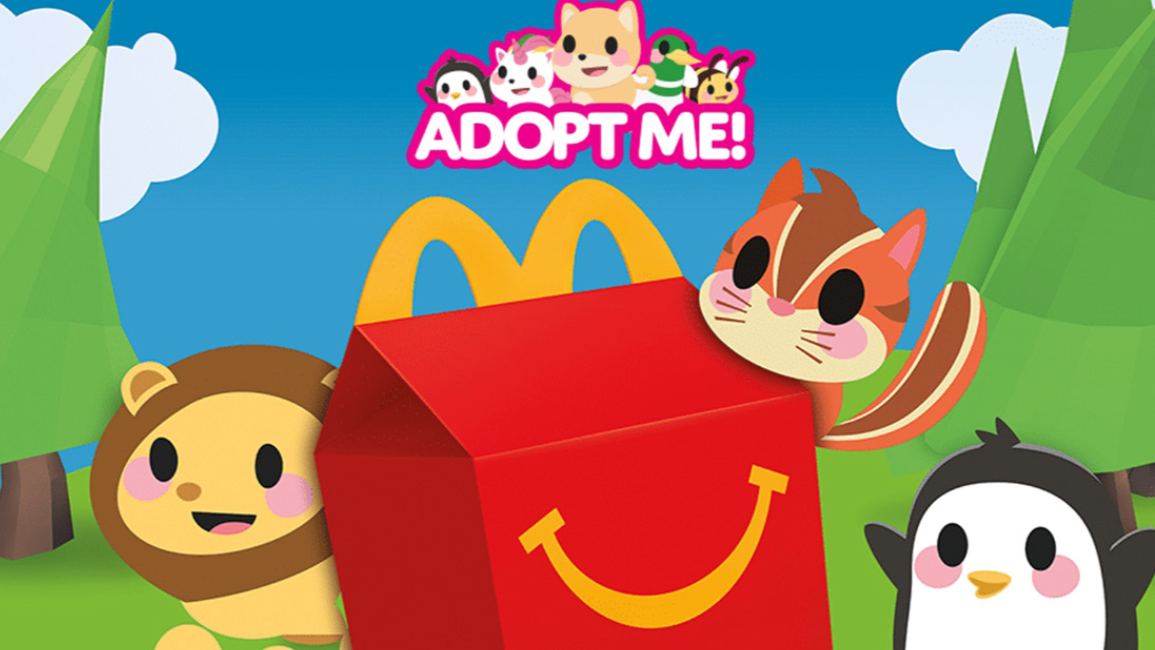
McDonald's partnered with two of Roblox's most popular games—Adopt Me! (40B+ monthly players) and Pet Simulator for a dedicated Happy Meal campaign.
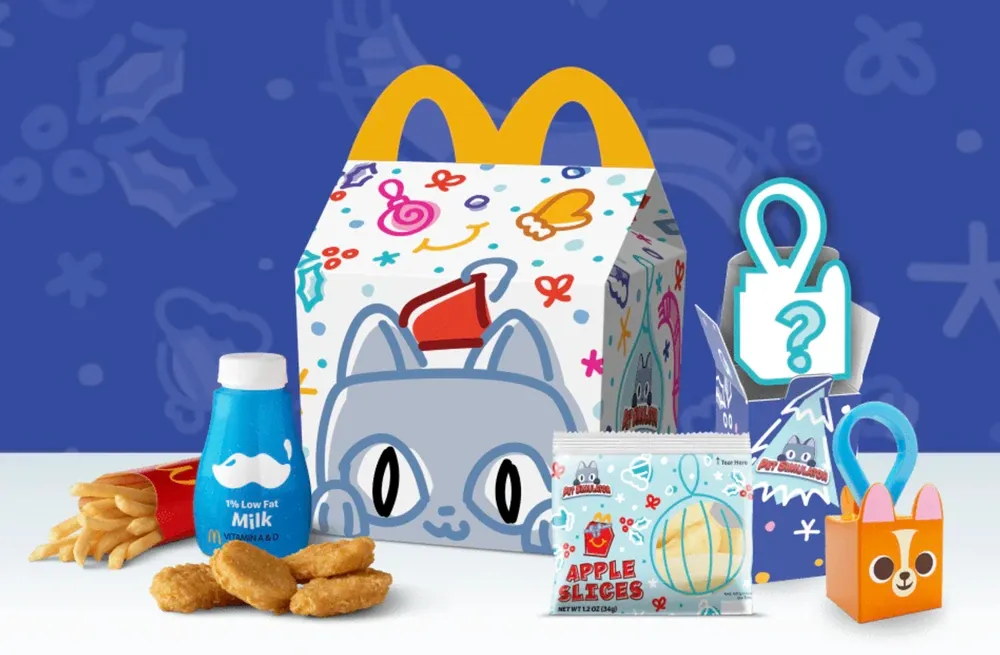
Here's the setup: Happy Meals include a collectible toy based on in-game pets or characters. Each toy comes with a redemption code or QR code. There are multiple toys in each collection (6-18 depending on the campaign). When kids enter the code in Roblox, they unlock an exclusive in-game pet or item that's ONLY available through Happy Meal purchase.
The business model is simple but powerful. Let's breakdown the growth levers that made this work:
🟦Four Growth Levers
Lever 1: Partner With Winning experiences
Why Adopt Me!? It has 40B+ monthly players, is consistently in Roblox's top played games, targets the perfect demographic (6-12 years old), frequently hits 500K+ peak users, and its pet collection gameplay aligns perfectly with toy promotion.
Pet Simulator offered similar benefits—another top Roblox game with pet collection mechanics and a highly engaged player base.
By partnering, McDonald's avoided starting from 0 players, cut development time, slashed production costs, and leveraged games that already had massive, engaged audiences.
Lever 2: The Collectible Mechanic
McDonald's tapped into psychological triggers that drive repeat purchases.
The setup is simple: 6-18 toys per collection (varies by campaign), each Happy Meal includes ONE random toy, campaigns run 4-6 weeks, and items are exclusive.
Get them before they're gone!
This triggers three responses. First, FOMO—limited campaigns create urgency, and kids see friends with toys they don’t have. Second, social currency—exclusive toys become status symbols, creating peer pressure. Third, completion compulsion—partial collections feel incomplete, driving multiple purchases and trading duplicates.
The math: a 6-toy collection means at least 8-10 visits. Total campaign spend per family average: $120-320 (Happy meal/kid + parent(s) meal = $15-40 per visit). Now multiply by thousands of families per location.
Lever 3: The Phygital Loop
This is the genius move that separates McDonald's from other brands. Creatz an engagement loop similarly to McDonald's Land:
- Kids play Adopt Me! on Roblox and notice unique McDonald's pets => Buys Happy Meal to collect pets
- Kids buy Happy Meal => use code to unlock pets on Roblox.
Level 4: Organic Amplification
Here's where it gets really interesting. Crispy Tattoo Island required paid influencers (estimated $50K-100K) to generate 3M+ reach and 143K visits. The phygital Happy Meals? Zero influencer spending.
For Pet Simulator Happy Meal, organic TikTok and YouTube Short content exploded across hashtags. The toys became the marketing.
Adopt Me! Happy Meal followed suit—kids and parents created content through word-of-mouth in the Roblox community.
The physical toys gave people something tangible to create content about—unboxing videos, collection showcases, toy reviews—which is to perfect formula for organic content.
Games build awareness, while phygital drives restaurant visits.
This drive faster results because standalone games need to time build an audience from zero, while phygital taps into enormous existing player base, drives measurable ROI, and builds organic reach.
Strategy #3: Cross-Platform Iteration
McDonald's didn't stop experimenting. They continued testing new formats and expanded beyond Roblox.
🟩Fortnite (2025)
McDonald's brought McDonaldland to Fortnite, featuring classic characters (Ronald McDonald, Grimace, Birdie, Mayor McCheese) with mini-games and branded areas. The app integration mirrored their Roblox approach: Order a "McDonaldland Meal" via the McDonald's app to unlock a secret Fortnite area.
McDonald's isn't betting everything on one platform. They're testing whether the same phygital mechanics that worked on Roblox (physical purchase → digital unlock) translate to other gaming platforms.
What the Data Shows🧾
🟧Performance Comparison
| Game/Activation | Visits | Paid growth | Reach | Orders | Rank |
|---|---|---|---|---|---|
| Crispy Tattoo Island (Italy) | 143K | High | 1 country | Not disclosed | Bottom tier |
| McDonald's Land (LATAM) | 435K | Medium | 10+ countries | 37K+ | Mid tier |
| Adopt Me! Happy Meal | 40B+ players | $0 | EU/ME/Korea | Millions | / |
| Pet Simulator Happy Meal | 2B+ | $0 | Multiple markets | Millions | / |
🟧The Strategic Shift
Even as McDonald's was pivoting to game activation, they kept experimenting with owned games. The difference? By 2024, they'd learned to build phygital mechanics directly into game design, creating measurable connections to real-world business rather than hoping for brand awareness alone.
Standalone branded games face an uphill battle on Roblox, regardless of brand size or marketing budget.
Looking at top performing branded Roblox games (tracked by RoMonitor) you can see the challenge clearly:
McDonald's games ranked far below mid-tier games from brands like IKEA (8M), Chipotle (36M), Nike (37M), and Gucci (49M) which fall in the 10M-100M range-with McDonald's Land sitting at 435K.
While McDonald's hasn't disclosed exact spending, industry estimates suggest standalone game campaigns require $100K-500K for development + influencer marketing, while phygital campaigns with popular games involve less costs (still need to pay the game to integrate your brand), less development time, and with minimal paid marketing.
Phygital beats pure digital for a brand like McDonald's with massive physical distribution.
McDonald's learned what many brands are still figuring out. Don't ask "How do we build a successful Roblox game?" Ask "How do we use Roblox to drive our core business?"
For McDonald's, the core business is restaurant visits and food sales. Standalone games might build brand awareness, but phygital Happy Meals drive actual transactions with measurable ROI.
Lessons for Brands
McDonald's four-year Roblox journey offers clear lessons for any brand considering their next move on the platform.
🟨Test Multiple Approaches
McDonald's didn’t commit to one strategy. They tested standalone branded experiences (McDonald's Land, Crispy Tattoo Island), influencer campaigns (3M+ reach), phygital Happy Meal integrations (Adopt Me, Pet Simulator), tycoon games with phygital mechanics (McDonald's Land Tycoon), and cross-platform expansion (Fortnite).
The takeaway: treat Roblox like a portfolio, not a single bet. Allocate budget across multiple experiments to see what resonates with your specific audience and business model.
🟨Understand the "cost" of building Standalone Game
Yes building standalone games on Roblox is hard, even for major brands. Only about 10% of branded games achieve 100M+ visits.
The reality check: standalone games are expensive, quickly forgotten and result in empty lobby after the initial hype.
The takeaway: worth it IF you're an entertainment brand with gaming-native IP, $500K+ budget, 6-12 month timeline to commit to ongoing updates and live operations => deep brand immersion (not immediate ROI).
🟨Leverage Existing Audiences
McDonald's biggest wins came from partnering with games that already had large audiences, not building from scratch.
Distribution > Creation
Top brand integrations get 2X the impressions of standalone games, they scale from day 1, while standalone games face an uphill climb.
The takeaway: partner with popular games with a player base who match your target audience, create exclusive in-game items tied to real-world products, sponsor in-game events, and collaborate with developers on branded content.
🟨Phygital Beats Pure Digital
For brands with physical products, phygital strategies deliver better ROI than pure digital plays.
Let's be honest, phygital rewards it's also more fun for players!
Phygital works => it mixes digital engagement with real-world transactions, creates measurable attribution (promo codes, QR codes), leverages existing distribution (e.g., McDonald's 40K+ locations) and drives store visits and sales.
The takeaway: retail brands can tie Roblox items to in-store purchases, add codes to packaging, and reward store visits. Use limited-edition, create collectibles. Entertainment brands can link movie tickets, merchandise, or subscriptions to in-game items.
🟨Organic > Paid (with right product)
McDonald's Crispy Tattoo Island spent $50K-100K on influencers for 3M+ reach and 143K visits. Their phygital Happy Meals spent $0 on influencers but generated massive organic buzz, millions of purchases, and sustained word-of-mouth.
The takeaway: If your product creates natural content opportunities—unboxing, collecting, showing off—you don’t need influencers. The product markets itself.
Paid influencers are better for pure digital experiences, awareness for new concepts/markets or competitive categories requiring an initial push.
🟨Start Small
McDonald's tested regionally before scaling globally. They launched Happy Meals in Austria with 6 toys, expanded with Pet Simulator in more regions, and scaled Adopt Me! across Europe, the Middle East, and Korea.
The takeaway: Validate concepts with regional tests before committing to global rollouts. Ikea is doing this now with an activation with Welcome to Bloxburg.
✋The Verdict
McDonald's didn't crack Roblox by building the best game or running the biggest influencer campaign. They cracked it by testing everything, measuring what worked, and doubling down on strategies that drove their core business.
The evolution from standalone games to phygital Happy Meals shows a brand that's willing to experiment, pivot based on data, and prioritize business impact over vanity metrics.
McDonald's stopped trying to compete with top Roblox games and started using Roblox as a distribution channel for their real-world business.
Three takeaways for brands:
- Standalone games are challenging even for major brands—understand the risk before committing significant budget. Does it even make sense for players?
- If you have physical distribution, phygital strategies will outperform pure digital plays and can achieve organic reach, even without influencer spend.
- Roblox isn't a campaign, it's a platform—success requires testing, iteration, and willingness to pivot.
- Creator partnerships, when relevant, amplify Roblox marketing efforts across all strategies
McDonald's journey proves that the brands winning on Roblox aren't the ones with the biggest budgets—they're the ones willing to experiment, learn from what doesn't work, and double down on what drives real business results.
What's your Roblox strategy? Are you building, integrating, or going phygital?💬
Thanks for reading Bloxprint! Share if with someone who might like it💜